
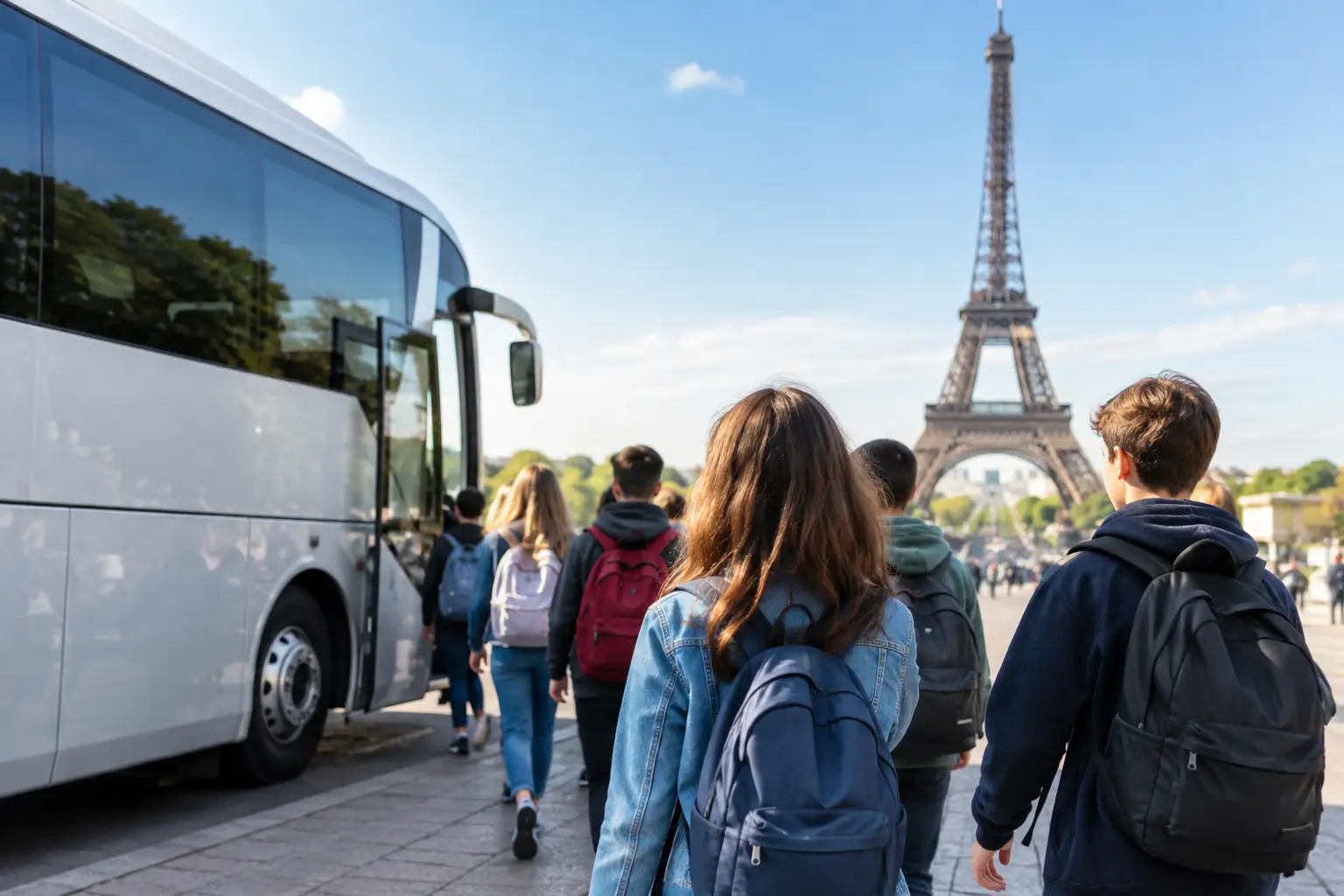
A school trip can lose valuable time before the first museum visit if pupils, teachers and luggage are left trying to work out airport transport. School group transport should give the party one clear plan from arrival hall to accommodation, with enough room for every traveller and a driver who knows where the group needs to be.
For schools travelling to Paris or Disneyland Paris, the priority is not finding the cheapest journey on the day. It is arranging a reliable transfer in advance, so staff can focus on headcounts, passports and the pupils in their care rather than queues, ticket machines or unfamiliar routes.
School group transport starts with an accurate headcount
The right vehicle depends on more than the number of seats. A group of 12 pupils and three teachers arriving with cabin cases needs a different arrangement from a party carrying large suitcases, musical instruments, sports equipment or pushchairs for younger children. Confirm the final passenger total and expected luggage before booking, then allow for last-minute changes where possible.
It is also worth deciding early whether the party should travel together or in coordinated vehicles. Keeping everyone in one vehicle can make supervision easier for a smaller group. For a larger school party, two or more vehicles may be more practical, provided each has a named staff lead and the same confirmed destination. The best choice depends on group size, luggage and the transfer options available for the travel date.
A pre-booked service gives organisers clarity on capacity before anyone lands. It also avoids the awkward situation where a vehicle arrives but cannot safely accommodate all passengers and bags.
Plan the airport transfer around the whole itinerary
A flight arrival time is only the start of the journey. International arrivals need time for passport control, baggage reclaim and gathering the group at an agreed point. Pupils may emerge from the terminal at different speeds, and one delayed suitcase can affect the whole party. Build this into the schedule rather than booking a transfer at the exact minute the aircraft is due to land.
For arrivals at Charles de Gaulle Airport or Orly Airport, clear meeting instructions are particularly useful. Before departure, every teacher should know the terminal, meeting point, lead traveller’s contact details and the plan if a pupil becomes separated from the group. Pupils do not need every operational detail, but they should understand the simple rule: stay with their allocated adult until the whole party is together.
Return transfers deserve the same care. Check the airline’s recommended arrival time, consider Paris traffic and allow enough time to load luggage. An early departure from the hotel is often preferable to an anxious rush through a busy terminal. Fixed, pre-arranged timings make it easier for teachers to share one itinerary with parents and school leaders.
Direct transport saves energy for the day ahead
Public transport can be an excellent way to explore Paris during a visit, but it is not always the strongest option straight after a flight. Managing a large group through station barriers, platforms, interchanges and peak-hour crowds takes time and close supervision. It can also be difficult when luggage is involved.
Door-to-door transport removes those changes of pace. The group travels from the airport to its hotel, hostel, private address or Disneyland accommodation without needing to split up to buy tickets or find the correct line. That matters most for younger pupils, first-time visitors and groups arriving late in the evening.
The trade-off is that private transport should be booked with the right vehicle size and timetable, rather than treated as a last-minute arrangement. When it is planned properly, the benefit is a calmer first hour in Paris and a more organised start to the programme.
Give the transport provider the details that matter
A good booking request is specific. Flight number, airport, arrival or departure time, group size, luggage estimate and full destination are the essentials. Include the name and mobile number of the lead teacher, as well as any mobility requirements. If there are several vehicles, confirm how the party will be divided before travel day.
Accommodation details should be precise, especially when the hotel entrance is on a side street or the group is staying near a pedestrian area. For Disneyland Paris, state the exact hotel or residence rather than simply writing “Disneyland”. Small details prevent delays when the driver is trying to identify the correct drop-off point.
It helps to share a simple staff allocation too. For example, one adult can lead pupils from baggage reclaim, another can complete a final headcount at the meeting point, and a third can check that luggage has been loaded. This is not about making the arrival overly formal. It gives each teacher a clear task during the busiest part of the transfer.
Keep safeguarding practical and visible
Transport is part of the school trip’s safeguarding plan, not merely a journey between two places. Teachers should maintain their usual ratios, use an up-to-date register and count pupils when leaving the terminal, entering the vehicle and arriving at the destination. A seating plan is not always necessary, but knowing which adult is responsible for which subgroup can be helpful.
Make sure every pupil has the accommodation name, the lead teacher’s contact number and a basic instruction for what to do if they are separated from the party. Younger children may benefit from a card kept in a pocket or lanyard. For older pupils, the emphasis may be on keeping phones charged and staying with their assigned group.
Staff should also check that luggage is collected before leaving the vehicle. A coach bag, a school rucksack or a passport pouch is much easier to retrieve at the drop-off point than after the driver has continued to another job.
Why fixed planning helps schools manage costs
A school trip budget has little room for unexpected transport costs. Pre-booking makes it easier to understand the journey price before departure and to allocate costs across the group. It also reduces reliance on several taxis, where vehicle availability, fares and luggage capacity can vary.
The lowest advertised option is not always the best value for a school party. Consider what is included: airport collection, waiting arrangements, vehicle capacity, direct travel to the accommodation and support if flight details change. A lower price can become less attractive if the group must make multiple connections or divide between vehicles without a clear plan.
For travel agents and school trip organisers, confirming the transfer alongside flights and accommodation keeps the itinerary joined up. It gives families a clearer picture of how pupils will travel on arrival and departure, and it gives staff fewer arrangements to chase close to the departure date.
Build a simple transfer plan before departure
Around one week before travel, reconfirm passenger numbers, flight details, luggage expectations and the lead contact. Give staff a printed copy of the transfer information as well as a digital version. Mobile signal, flat batteries and busy airport areas can make a paper backup surprisingly useful.
On the day, nominate one person to communicate with the transport provider if needed. Too many separate calls can create confusion, particularly if the flight is delayed. The lead teacher can receive updates, while other staff continue supervising pupils and checking the register.
Paris Shuttle One helps groups travelling between Paris airports, central Paris and Disneyland Paris with pre-arranged, door-to-door transfers and multilingual support. For a school party, the practical value is simple: one confirmed journey, a clear pick-up plan and less uncertainty at the point when staff have the most to manage.
A well-planned transfer will not make the airport quiet or remove every delay, but it gives the group a calm structure when plans change. Start with the correct headcount, leave realistic time around the flight and make sure every adult knows the next meeting point. Then the first stop on the school trip can be the one everyone came to see.