
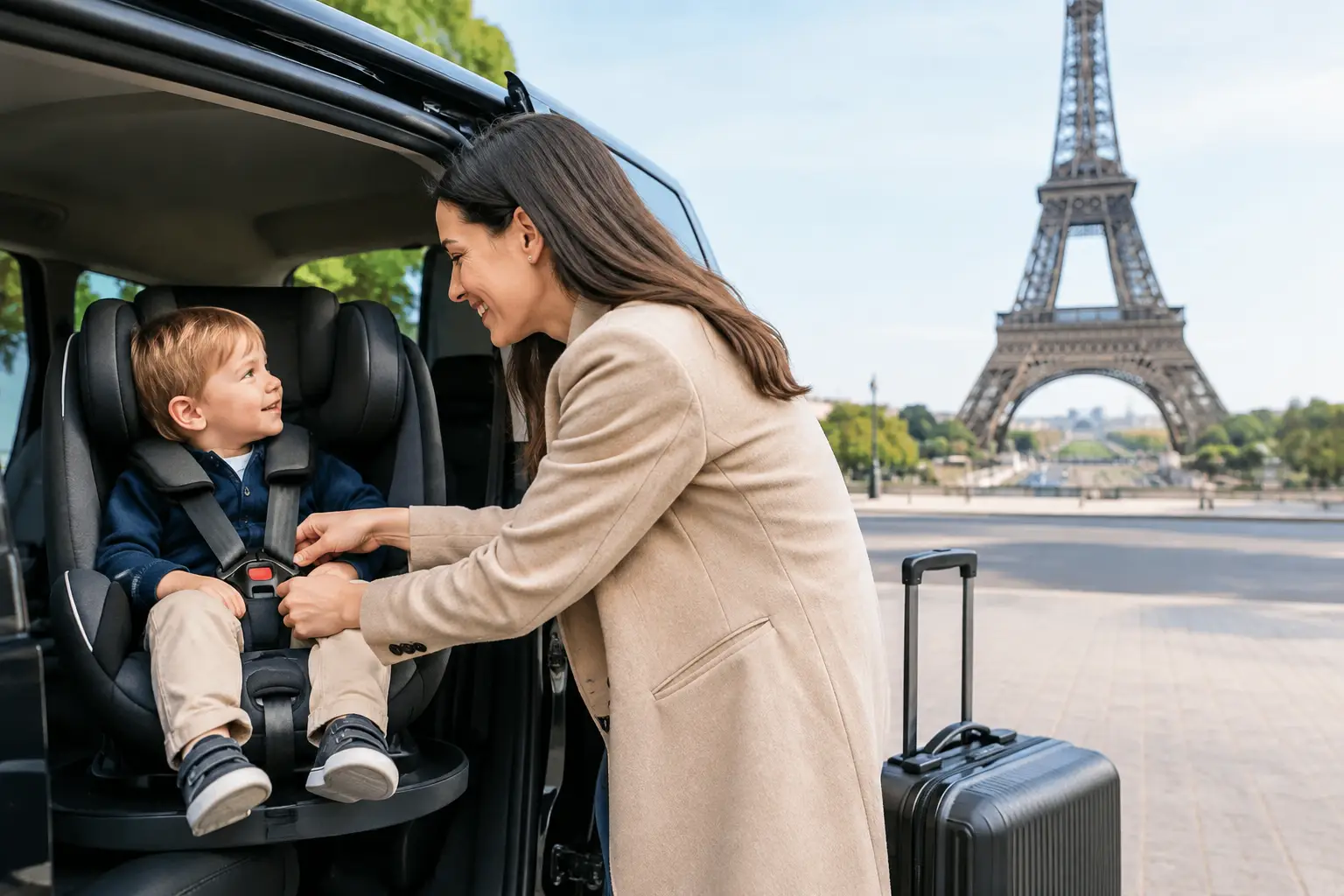
A tired child, several suitcases and a busy arrivals hall are not the moment to start asking whether a suitable car seat is available. Knowing how to request child seats before you book your Paris airport transfer helps your family leave Charles de Gaulle, Orly or Disneyland Paris without an avoidable delay. The key is simple: request the seat during booking, give accurate details for each child, and make sure the request has been confirmed.
For families, a pre-arranged transfer is about more than getting from A to B. It means a vehicle sized for your group, room for luggage, and a safe, comfortable place for younger passengers from the start of the journey. A few extra minutes spent on the booking details can make a long travel day feel much more manageable.
How to Request Child Seats When Booking
The best time to request a child seat is when you make your transfer reservation, not when you arrive at the airport. Child seats are specialist equipment and need to be assigned to the right vehicle before collection. If your booking form includes a child-seat option, select it for every child who needs one. If there is a notes field or you are booking with customer support, state the requirement clearly.
For each child, provide their age, weight and height where possible. These details help the transfer provider allocate the most appropriate restraint. Age alone can be useful, but children of the same age can vary considerably in size. A three-year-old and a six-year-old may both need a different seat arrangement, even if they are travelling in the same family.
Also tell the provider how many adults and children are travelling, how much luggage you expect to bring, and whether you need a pushchair to travel in the vehicle. This allows the operations team to plan the vehicle capacity properly. A seven-seat vehicle may sound ideal for a large family, but space for bulky suitcases, a folded buggy and several child seats must be considered together.
Give the Details That Make a Difference
A clear request removes guesswork. Include your flight number for an airport collection, your destination address or hotel, the date and time of travel, and a mobile phone number that will work when you land. Then list each child’s requirements individually.
For example, a helpful booking note might say: “Two adults, two children. Child one: 18 months, 11 kg, 82 cm. Child two: 5 years, 19 kg, 110 cm. One folding pushchair and four medium suitcases.” This is far more useful than simply writing “two child seats needed”.
If you are unsure which seat type your child needs, do not guess. Share the child’s age, weight and height and ask the transfer team to advise on the available option. It is better to have that conversation before travel than to discover that the seat requested is not suitable on the day.
Infants, toddlers and older children
Very young children generally need a rear-facing infant seat or an appropriate baby seat, depending on their size. Toddlers usually require a forward-facing child seat with a harness, while older children may need a booster seat so that the vehicle seat belt sits correctly. The exact arrangement depends on the child and on the equipment available in the booked vehicle.
In France, children are generally required to use a suitable child restraint until they are 10 years old, unless a specific exception applies. This is why it is sensible to request a seat for any child who may still need one rather than relying on a short journey or assuming a standard taxi will have suitable equipment.
A child who is tall for their age may be ready for a booster, while a smaller child may still need a full harnessed seat. Safety and fit should guide the decision, not only the birthday on the passport.
Book Early, Especially During School Holidays
Child seats should be requested as early as possible, particularly for travel during school holidays, weekends, late-night arrivals and busy Disneyland Paris periods. There is often strong demand for family transfers at these times, and early booking gives the provider more time to prepare the correct vehicle and equipment.
Last-minute bookings can still be possible, but choice may be more limited. If a particular type of seat is essential, contact the provider before finalising your plans and ask for confirmation that it can be supplied. Do not assume that every vehicle carries every size of seat as standard.
Early booking is equally useful for return transfers. Your child will need the correct arrangement when leaving your Paris hotel or Disneyland accommodation just as much as on arrival. Add the return journey to the same reservation where possible, with the same child details, so nothing is missed.
Check Your Confirmation Before You Fly
Once your transfer is booked, read the confirmation carefully. Look for the number of passengers, collection time, flight details, destination, luggage information and child-seat request. If the child seats are not mentioned clearly, contact customer support promptly and ask for the booking to be updated.
This check matters because a confirmed transfer and a confirmed child-seat request are not always the same thing. A good booking record should make it clear that the provider has received your requirements. Keep the confirmation accessible on your mobile phone and, if you prefer, save a screenshot in case mobile signal is weak when you arrive.
It is also wise to confirm any special circumstances. Perhaps you are bringing a car seat of your own, travelling with twins, carrying a compact travel cot, or need a vehicle that can take a wheelchair as well as child restraints. These needs may affect vehicle selection, so they should never be left until collection time.
Should You Bring Your Own Child Seat?
Bringing your own seat can be a good option when your child is used to a particular model, when you want to use the same seat on several journeys, or when you will hire a car later in your holiday. It may also give you more control over the fit and familiarity of the equipment.
However, it adds luggage and can be awkward to carry through an airport, especially with a pushchair and hand baggage. If you plan to use your own seat, tell the transfer provider in advance. They can confirm whether it can be fitted safely in the allocated vehicle and whether you will need to store it during other parts of your trip.
For many visitors, requesting a seat from the transfer provider is the easier choice. It reduces what you need to carry and means the vehicle can arrive prepared for your family. The trade-off is that you should supply complete details early and check the request is confirmed.
What to Do When You Meet Your Driver
At collection, take a moment to check that the right number of seats has been fitted and that each one appears appropriate for your child. Do this before the vehicle leaves the airport or hotel. If anything does not match your confirmed request, raise it with the driver straight away so the issue can be addressed.
Parents and carers should place their child in the seat and make sure the harness or belt is properly adjusted. The driver can assist with practical information, but the adult travelling with the child is best placed to confirm that the child is comfortable and correctly secured. Remove thick coats if they prevent a harness from fitting snugly, and keep loose toys or heavy items safely packed away for the journey.
If your flight is delayed, follow the transfer provider’s arrival instructions and contact support when requested. Sharing your flight number at booking helps the team track changes, but it is still helpful to keep your mobile phone switched on after landing. Clear communication gives everyone the best chance of keeping the collection smooth.
Make the Whole Journey Easier for Your Family
A child seat is one part of a well-planned transfer, but small details can make the ride more relaxed. Keep essential items in hand luggage: water, snacks, wipes, a spare layer, medication and a favourite comfort toy. After a flight, children may be hungry, overtired or unsettled, so having familiar items close by can make the drive to Paris or Disneyland Paris much easier.
With Paris Shuttle One, families can request child seats as part of a pre-booked, door-to-door transfer and receive clear support before travel. Fixed arrangements and a prepared vehicle mean less uncertainty after landing and more time to focus on the holiday ahead.
Before you travel, take one final look at your booking: every child listed, every seat requested, every journey confirmed. That small check helps turn airport arrival from a logistical challenge into the first calm moment of your Paris stay.